THE INCOTERMS 2020 RULES

the incoterms 2024

What are the Incoterms 2020?

The current Shipping incoterms 2024 maintain the version of the incoterms 2020. They are a set of rules, known by their 3 -letter acronyms, that allow us to define the extent obligations or responsibilities in 4 aspects (risks, costs, transportation, and customs clearance) for both exporting and importing companies in the delivery of goods. On this page, we will show you the list of 11 incoterms, classification and incoterms chart 2020, their main changes and their structure.

The purpose of Incoterms or international shipping terms is to facilitate negotiations between the exporter and importer with clear rules and universal language. Similarly, the function of incoterms is to minimize risks in the commercialization of goods, providing the following information: Where the delivery of the merchandise takes place, who assumes the risks of that purchase-sale and to what extent, what mode of trasportation (maritime, land, or air) the goods will travel, and whether there in a obligation to insure the operation.

Advertisement

Complete List of Incoterms 2020: 11 Shipping Terms Explained

The list of Incoterms, developed by elaborated by the International Chamber of Commerce (ICC), which is responsible for establishing and regulating  Incoterms. Therefore, the ICC conducts a review,  adaptation, and creation of new incoterms every 10 years since 1980.

This list of shipping Incoterms 2020 is accepted by more than 45 million companies worldwide. Consequently, understanding the proper use of international trade terms  will allow the exporter to develop a better marketing strategy, whether using maritime or multimodal incoterms for dry, bulK, hazardous, frozen, refrigerated, and other types of cargo.

Advertisement

Multimodal transport incoterms:

EXW Incoterm

exw incoterms 2024 rules

Ex works shipping terms, the seller (Exporter) delivers the goods at his premises or other designated place, with no obligation to load the goods on the vehicle designated by the buyer.

The buyer (importer) assumes all responsibility from the loading and collection of the goods until the transfer to the country of destination.

FCA Incoterm

fca shipping terms 2024

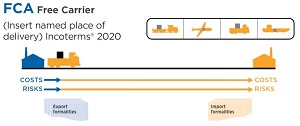
Free Carrier shipping – The seller (Exporter) is responsible for delivering the goods to the designated place, within the country of origin, with the obligation to load the goods onto the vehicle designated by the importer. It also assumes the costs, risks and the costs of export formalities.

The buyer may request the carrier to issue the B/L to be delivered to the seller for presentation to the bank.

CPT Incoterm

cpt incoterms 2024 rules

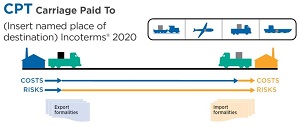
Carriage Paid To – The seller bears the cost of transportation to an agreed point for delivery of the goods, export and import customs clearance, but the risks (that the goods arrive in good condition, agreed quantity, or that they arrive at the point of destination) are transferred to the buyer from the loading on board.

CIP Incoterm

cip incoterms 2024 rules

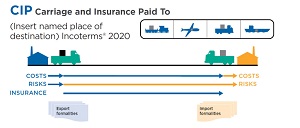
Carriage and insurance Pai To – The seller (Exporter) delivers the goods at the agreed place in the country of destination, assuming the costs of the main transport, export clearance and insurance. The risk ends for the exporter until the export process. 

The insurance must be of minimum coverage in favor of the buyer at 110% of the value at all risks, clause A of the London Insurance Institute.

Advertisement

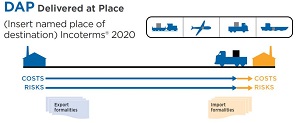
DAP Delivered at Place

dap shipping terms - the incoterms 2024 rules

Delivered at Place – The seller (exporter) delivers the goods anywhere in the country of destination at the request of the buyer, who assumes the import and unloading formalities at destination. After this point the risk and costs are of the buyer

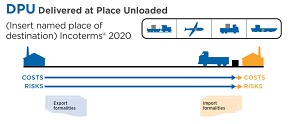
DPU Shipping

dpu incoterms 2024 rules

Delivered at Place Unloaded – The seller delivers the goods, unloaded, at any place agreed with the buyer, assuming the transportation and insurance of the goods.

The import formalities at the place of destination are the responsibility of the buyer.

DDP Delivered Duty Pait

ddp incoterms terms meaning 2020

Ddp meaning in shipping – The exporter or seller delivers the goods at any agreed place within the country of destination. The seller assumes all costs and risks up to unloading. The buyer assumes the risks and costs of unloading the goods.

Advertisement

Sea freight shipping incoterms

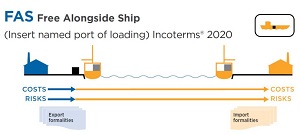
FAS Incoterm

fas alongside ship - incoterms 2020

Free alongside ship – the exporter is responsible for delivering the goods at the port of origin (loading dock), assuming the export formalities. The importer assumes the risks and costs when the goods are alongside the ship. This incoterms only applies to sea and river transport.

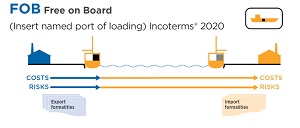
FOB Incoterm

Fob - Free on board incoterms 2020

Free on board  – The seller (exporter) delivers the goods on board the vessel, having assumed the costs, dispatches and risks up to that point. Granting the buyer the costs and risks up to the point of final destination

Advertisement

CFR Incoterm

cfr incoterms 2020

Cost and freight incoterms – The seller (Exporter) is responsible for delivering the goods on the ship, hiring and paying the main transport, including export formalities. But the risk during the journey is the buyer’s, as well as the import costs.

CIF Incoterm

cif incoterms 2020

Cost Insurance and Freight – The exporter is responsible for paying the main transport and insurance to the port of destination, assuming the costs of export clearance. The risk of the journey is the buyer’s.

The insurance must be of minimum coverage in favor of the buyer at 110% of the value at all risks, clause C of the London Insurance Institute.

Incoterms 2020 Comparison table and chart

We can classify the Shipping Incoterms 2020 in two ways: the traditional method, used prior to the 2010 version, which is based on the degree of obligation and divided into 4 groups (E, F, C, D). This classification system helps us to better understand the point of delivery of the goods.

The second method of classification of international shipping terms, introduced since the 2010 version and maintained in the 2020 version, is based on the mode of  transport and is divided into 2 groups: multimodal transport (land, air and rail) and sea freight incoterms.

Below, we present the two types of classification along with their respective incoterms tables to provide greater clarity to international transportation.

Advertisement

Incoterms according to degree of obligation

Grupo E : Direct at exit

EXW: Ex Works

Grupo F: Direct delivery.

FCA: Free Carrier

FAS: Free Alongside

FOB: Free On Board

 Grupo CIndirect delivery, but the main transport is paid .

CFR: Cos and Freiht

CIF: Cost, Insurance and Freight

CPT: Carriage Paid To

CIP:   Carriage and Insurance Pait to

Grupo D: Direct delivery.

DPU: Delivered At Place Unloaded

DAP: Delivered At Place

DDP: Delivered Duty Paid

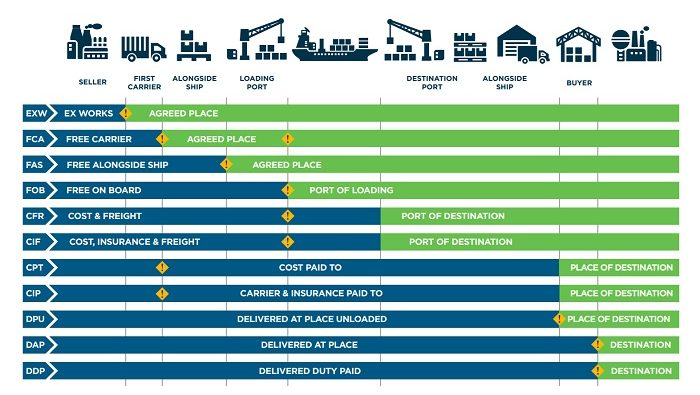
Incoterms chart

incoterms chart 2024

Fuente / picture: CAP Worldwide

Advertisement

Incoterms by means of transport

Rules for any modo or modes of transport

EXW: Ex Works 

FCA: Free Carrier

CPT: Carriage Paid To

CIP:   Carriage and Insurance Pait to

DAP: Delivered At Place

DPU: Delivered al place Unloaded

DDP: Delivered Duty Paid

 Rules for sea waterway transport

FAS: Free Alongside

FOB: Free On Board

CFR: Cos and Freiht

CIF: Cost, Insurance and Freight

Incoterms chart by means of transport

incoterms 2024 table

7 Main changes to incoterms 2020

Since 1936, when the first 6 Incoterms terms  appeared, until today, international trade terms have been revised 8 times (1953, 1967, 1974, 1980, 1990, 2000, 2010 and finally the 2020 version) due to the challenges faced by international trade over time.

Consequently, on January 1, 2020, the  international trade terms 2020 came into effect with some modifications compared to the Incoterms 2010 version. Below presnt the 7 main changes from Incoterms 2020.

Bill of lading with mention an «on board» notacion and the FCA Incoterms rule: An additional option is provided for the exporter to obtain the bill of lading (Bill of Landing on board, by the importer through its carrier, upon instruction when the goods are delivered. This document (B/L) with mention on board is requested by banks when there is a documentary credit, since it justifies the delivery of the goods.

Recall that under the FCA rule, only the Bill of Landing with mention on board is issued prior to loading on board the vessel.

Enumeration of costs: For the 2020 version, all costs assigned to each Incoterms rule are assigned a single numbering A9 / B9 (Cost apportionment) within the structure of the Incoterms. This, facilitating the location of all costs in a list.

Arranging for carriage with seller’s or buyer’s own means of transport in FCA, DAP, DPU, DDP: It is formalized (by contract of carriage) that both the seller and buyer may use their own means of transport to transport the goods without the need to hire a carrier or third party.

Advertisement

Different levels of insurance cover in CIF and CIP Incoterms : The 2010 version required the exporter to obtain cargo insurance that meets at least the minimum coverage provided by clauses (C) of the institute’s cargo clauses (LMA/IUA), both for CIF and CIP. For the 2020 version this changes, while the minimum coverage is maintained for CIF Incoterms, for CIP Incoterms  the exporter must obtain insurance that complies with clauses (A) of the Institute’s cargo clauses. However, for both cases it is left to the consideration of the parties a higher or lower coverage respectively.

Change in the three letter initials for DAT incoterms to DPU: This new incoterm replaces the DAT in the new version of the terms of international trade. Unlike the DAT, where the goods were delivered to an agreed terminal. The DPU Incoterms allows the goods to be delivered at any place of destination and not only at a terminal.

Inclusion of safety-related requirements withim carriage obligations and costs: The requirements are included in Articles A4 (Transport) and A7 (Export/Import Duty).

Explanatory notes for users: The explanatory notes explain when an incoterms should be used, at what point a risk is passed on how costs are allocated between an exporter and importer in international trade, the explanatory notes replace the guidance notes in the 2010 version.

It is worth mentioning that revisions and/or updates do not eliminate previous versions. Therefore, the type of incoterms, place of destination and version must be specified in the purchase and sales contracts. For example CIF Callao, Peru incoterms 2020

Order within the International commercial terms 2020 

The international shipping terms have a structure based on 10 articles and that in the 2020 version their sequence has been modified, so that the differences between the incoterms rules can be identified more easily. Therefore, we will mention the 10 articles (obligations) of the incoterms 2020 rules for both the exporter and the importer.

  • General obligations
  • Delivery – Taking delivery
  • Transfer of risks
  • Carriage
  • Insurance
  • Delivery – Transport document
  • Export – import clearance 
  • Checking – packaging – marking
  • Allocation of costs
  • Notices.

*Disclaimer: This page is not legal advice, and the information provided is not the official legal or full definition of each Incoterm®. you are encouraged to conduct your own due diligence and to consult legal counsel as appropriate. Licensed freight forwarders may also be helpful.