International Trade Agreements: Key Drivers of Global Economic Growth
International trade agreements play a pivotal role in fostering economic, financial, political, and environmental cooperation between nations. These preferential trade agreements establish frameworks that eliminate barriers to trade, promote economic growth, and enhance competitiveness across borders.
By facilitating the free flow of goods, services, and investments, international trade deals empower member countries to achieve shared objectives, such as job creation, export growth, and sustainable development.
Given their critical importance, countries worldwide have adopted various types of international trade agreements tailored to their economic strategies. Among these, FTAs stand out as a cornerstone of global trade policy, offering significant advantages to participating nations. Examples include the USMCA Agreement, RCEP, the European Union – Canada Free Trade Agreement, among others.
Advertisement
What are Free Trade Agreements (FTAs) and Why do they matter?
Free Trade Agreements are among the most impactful types of trade agreements, designed to eliminate or reduce tariffs and non-tariff barriers between member countries. These agreements provide exporters and importers with preferential treatment, fostering competitive procing and improved market access.
Beyond tariff reductions, FTAs address regulatory challenges, ensuring greater predictability and legal certainty in international business. Key areas covered by FTAs include: Investment Protections, E-commerce Regulations, Intellectual Property Rights, Labor Standards, Financial Services, among others.
By incorporating these aspects, the Free Trade agreement countries non only streamline trade but also promote long-term economic stability and integration.
«The WTO operates the global system of trade rules and helps developing countries build their trade capacity. It also provides a forum for its members to negotiate trade agreements and to resolve the trade problems they face with each other.»
«The WTO agreements cover goods, services and intellectual property. They spell out the principles of liberalization, and the permitted exceptions.»
*note: WTO official website
Top 10 Free Trade Agreements Shaping Trade in 2025
USMCA Trade Agreement
The USMCA (United States-Mexico-Canada Agreement) is the free trade agreement between Mexico, the United States, and Canada that replaced NAFTA and came into effect on July 1, 2020. This agreement was designed to provide greater certainty and stability for trade and investment among the member countries.
The trade agreement includes new provisions in areas such as small and medium-sized enterprises (SMEs), environmental protection, anti-corruption, digital trade, and labor rights, promoting a more inclusive, responsible, and trend-aligned regional trade framework.
EU-Japan Economic Partnership Agreement
«The EU-Japan Economic Partnership Agreement entered into force on February 1, 2019. With its implementation, the agreement eliminated 99% of the EU’s tariff lines and 97% of Japan’s tariff lines. For the tariffs that have not yet been eliminated, tariff quotas or tariff reductions were agreed upon. Every year, EU companies export more than 58 billion euros in goods and 28 billion euros in services to Japan.»
Advertisement
EU-Canada Comprehensive and Economic Trade Agreement
«CETA (Comprehensive Economic and Trade Agreement) is a trade agreement between the EU and Canada. It reduces tariffs and facilitates the export of goods and services, benefiting individuals and businesses in both the EU and Canada.
CETA provisionally entered into force on September 21, 2017, meaning that most of the agreement is now in effect. The national parliaments of EU member countries, and in some cases regional parliaments, must approve CETA before it can fully come into force.»
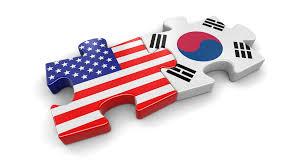
Korea US Free Trade Agreement
The Free Trade Agreement between the United States and South Korea, signed on June 30, 2007, entered into force on March 15, 2012, after a five-year period. Currently, most industrial and consumer goods from South Korea enter the United States duty-free and exempt from the Merchandise Processing Fee (MPF)
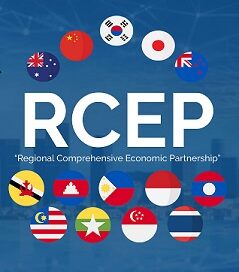
«The international trade treaty RCEP is a modern and comprehensive free trade agreement. It covers trade in goods, services, investments, creates new rules for e-commerce, and competition in government procurement.»
«It entered into force on January 1, 2022, with 15 member countries (Cambodia, Indonesia, Laos, Malaysia, Myanmar, Philippines, Singapore, Thailand, Viernam, China, Japan, South Korea, Australia and New Zealand) that together represent a market of 2.3 billion inhabitants.»
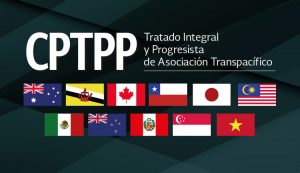
CPTPP - Comprehensive and Progressive Agreements for Trans-Pacific Partnership
The Comprehensive and Progressive Agreement for Trans-Pacific Partnership (CPTPP) is one of the most advanced and far-reaching trade agreements in the world. This landmark pact covers a wide array of economic and trade areas, setting a benchmark for modern trade policies.
The agreement goes beyond traditional trade in goods by including: Services, Investments, intellectual property rights, environmental protection and labor standarsd.
Advertisement
European Union Mercosur Free Trade Agreement
«On December 6, 2024, finally after 25 years, Mercosur and the European Union concluded negotiations for a strategic partnership agreement, which entails $100 billion in bilateral trade for a market of 720 million people.
This freetrade agreement, involves 32 countries, will give rise to the largest free trade area in the world.»
ASEAN Free Trade Area
«The ASEAN Free Trade Area was established in January 1992 with the aim of eliminating tariff barriers among Southeast Asian countries, integrating ASEAN economies into a single production base, and creating a regional market of 500 million people. ASEAN member countries have reduced their tariffs on intra-regional trade to no more than five percent for almost all products included in the Inclusion List or have eliminated them entirely.»
EU-South Korea Free Trade Agreement
«Since 2011, the EU-South Koreatrade agreement has eliminated customs duties on nearly all products (98.7%), including fisheries and agricultural products. It has also removed non-tariff barriers (NTB) to the exports of key EU products to South Korea, such as automobiles, pharmaceuticals, electronics and chemicals. Not the least, services markets in both the EU and South Korea have largely opened to businesses and investors from each other.»
African Continental Free Trade Area (AFCFTA)
The AfCFTA, or African Continental Free Trade Area, is the treaty With the largest number of participating countries, encompassing 55 African nations and a population of over 1.3 billion people. Its primary goal is to accelerate intra-African trade, and enhancing Africa’s position in the global market. The free trade agreement also aims to foster economic integration and industrialization for the sustainable development of the member countries.
Advertisement
Trade Agreements
Trade agreements are essential for global economic integration and are supported by the regulations of the World Trade Organization. In addition to their economic benefits, these agreements promote political, social, and environmental integration among participating countries. Below, we present some of the most significant agreements at the international level.
International trade agreement EFTA
The international trade agreement EFTA was established on January 4, 1960, with the aim of liberalizing trade and promoting economic integration among its members. Its headquarters are located in Geneva, Switzerland.
Australia - UK FTA
Australia – United Kingdom free trade agreement seeks to create new export opportunities and jobs for businesses by removing tariff on more than 99 per cent of Australian goods exports to the United Kingdom.
The EU - UK Trade Agreement
«The EU-UK Trade and Cooperation Agreement concluded between the EU and the UK sets out preferential arrangements in areas such as trade in goods and in services, digital trade, and many aspects of cooperation.«
Mercosur
«Common space that integrates 5 South American countries since March 26, 1991, the date on which the treaty was signed, was created to generate commercial and investment opportunities through the competitive integration of its members into the international market.«
European Union (EU)
«Founded on November 1, 1993, headquartered in Brussels, Belgium. This «economic and political partnership that has allowed the formation of a large economic bloc, made up of 27 European countries.»
ANZCERTA
«The CER Agreement is one of the most comprehensive bilateral free trade agreements in existence. It covers substantially all trans-Tasman trade in goods, including agricultural products, and was the first to include free trade in services.»
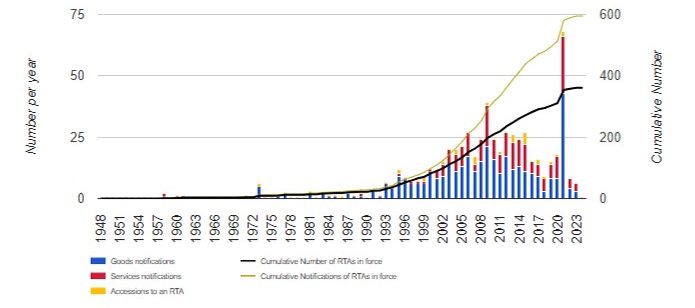
Evolution of international trade agreements 1948 - 2024
According to the World Trade Organization (WTO), as of January 1, 2024, there are 361 active trade agreements, as shown in the ‘Evolution of Active Trade Agreements 1948 – 2024’ graph. Of these, 167 are related to goods, 2 to services, and 186 to both goods and services.
We can observe from the graph how the number of international trade agreements has been increasing since the 1990s, as well as the growth of notifications related to the services sector since the year 2000, representing more than 20% of international trade. In 2020 alone, the value of exports was nearly US$ 20 trillion.
It is expected that in the coming years there will be an increase in the signing of new international trade agreements and memberships. Currently, the WTO has around 600 notifications of active trade agreements.